Hope
Finding Enough Light
to Take the Next Step

Finding enough light for the next step
Finding Enough Light to Take the Next Step
If there is one thing for certain, it is that we will all go through dark seasons in life.
And when it is dark and the future is unclear, it can be difficult to imagine things being any different from how they are right now.
You can’t see how things get better.
You can’t see a way out of the situation you’re in.
Or perhaps you can see where you’d like to be, but the distance between here and there feels so large that you can’t imagine yourself ever getting there.
And when you’ve been struggling for long enough, hope can start to sound almost insulting.
“Things will get better.”
“Stay positive.”
“Just keep going.”
Easy things to say when you’re not the person standing in the dark.
But having hope doesn’t have to mean relying on the abstract idea that everything will work out just fine – especially when, right now, you can’t see how it possibly could.
Psychologist C. R. Snyder studied hope, and his work offers us something more practical.
Hope can be built.
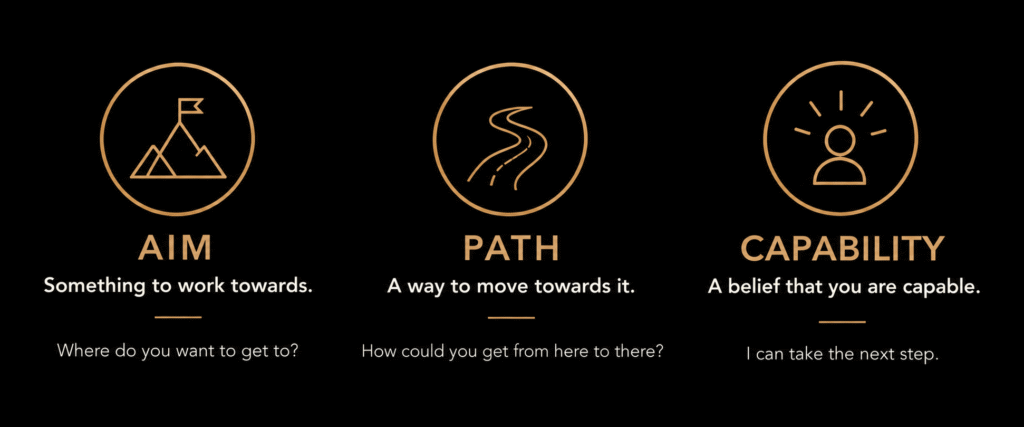
And it starts with three things:
Something to aim for.
A way to move towards it.
And a belief that you are capable of doing so.
1. Something to Aim For
The first part of hope is having a goal or target.
That might sound obvious, but when you’re struggling, it can be difficult to answer a simple question:
What would better look like?
Not ideal.
Just better.
Maybe you want to feel healthier.
Maybe you want to get out of debt.
Maybe you want to find a different job.
Maybe you want to repair a relationship.
Maybe you want to feel like yourself again.
The goal gives you a direction.
You don’t need to know exactly how you’re going to get there yet.
You just need something on the horizon to move towards.
A small beacon of light in the distance.
2. A Way to Move Towards It
Once you have a goal in mind, it is about route planning. Knowing where you want to go isn’t quite enough.
You also need to be able to see some kind of route between where you are and where you want to be.
Snyder called these pathways.
Essentially:
How could I get from here to there?
If you want to feel healthier, maybe the, literal, first step is getting out for a walk in the morning, joining a fitness class or cooking yourself a decent meal tonight.
If you want to get out of debt, maybe it’s cancelling a subscription you don’t use, paying an extra £20 off a credit card or putting £10 into savings.
If you want to find a different job, maybe it’s sending one application, updating your CV or messaging someone who works in an industry you’re interested in.
If you want to repair a relationship, maybe it’s picking up the phone, sending a message or saying sorry.
And if you just want to feel like yourself again, perhaps the first step is asking yourself what has changed – and what small part of your old life you could begin to bring back.
There doesn’t have to be one path.
There rarely is.
You try something.
You encounter an obstacle.
You adjust.
You learn.
This is important because hopelessness can grow when we mistake one blocked path for there being no path at all.
You applied for the job and didn’t get it.
The diet didn’t work.
The relationship ended.
The treatment didn’t help.
The business failed.
Sometimes the road ahead is blocked. That doesn’t mean you can’t get there. You might just need a detour.
And when you’re standing in the dark, you don’t need to see the entire road ahead anyway.
You just need enough light to see the next few steps.
3. Believing You Are Capable
This might be the most important part.
Because you can have something you desperately want.
You can even have a perfectly reasonable plan for achieving it.
But somewhere inside you there can still be a voice saying:
“I can’t do it.”
And that is where hope can disappear.
Snyder referred to this part as agency – the belief that you can act and that your actions can make a difference.
Sometimes it is difficult to picture yourself doing something you’ve never done before.
If you’ve never lost 30kg, how are you supposed to know that you can?
If you’ve never run a business, changed career, gone back to education or rebuilt your life after something has fallen apart, there is always going to be some uncertainty.
So when you can’t find evidence by looking forward, it can help to look backwards.
Look Behind You
Think about something in your life that you once weren’t sure you could do.
It doesn’t have to have anything to do with the problem you’re facing now.
Maybe you lost a parent.
Moved somewhere new.
Completed a degree.
Learned a skill.
Got through a breakup.
Or simply survived a period of your life that, at the time, you weren’t sure you would get through.
While none of these things prove you can do what’s ahead, they show something else:
Evidence of capability.
Evidence that you’ve faced uncertainty before.
That you’ve learned.
Adapted.
Kept going.
Navigated hurdles.
Figured things out.
You don’t need evidence that you’ve done this before.
You need evidence that you are capable of doing difficult things you haven’t done before.
You Don’t Need to Believe Everything Will Be Okay
I think this is where our usual idea of hope gets it wrong.
Hope isn’t certainty.
It isn’t pretending things aren’t difficult.
And it isn’t telling yourself that everything is definitely going to work out exactly as you’d like.
Sometimes circumstances really are difficult.
Sometimes the path ahead is uncertain.
Sometimes things don’t work out.
Hope isn’t about knowing everything will be okay. It’s about being able to see a way forward.
It’s being able to say:
There is somewhere I’d like to get to.
There might be a way of getting there.
And I am capable of taking the next step.
You might not be able to see much further than that.
That’s okay.
Because when you’re standing in the dark, you don’t need the whole road to suddenly light up.
You don’t even need to see the light at the end of the tunnel.
Sometimes you just need enough light to take the next step.
Want to Put This Into Practice?
If this article has got you thinking about making a change, our
Thrive Day 1: Setting the Stage for Lasting Change
course is a good place to start.
It will help you think more clearly about what you want to change, why it matters and how to start moving in the right direction.
Enter your details below and I’ll send you access.
No spam. Just useful stuff to help you make positive changes. Unsubscribe anytime.
Want to Put This Into Practice?
If this article has got you thinking about making a change, our
Thrive Day 1: Setting the Stage for Lasting Change
course is a good place to start.
It will help you think more clearly about what you want to change, why it matters and how to start moving in the right direction.
Enter your details below and I’ll send you access.
No spam. Just useful stuff to help you make positive changes. Unsubscribe anytime.